



Google uses data like no other company, and with the Moto X it took
an average of what screen size is acceptable to most consumers, the most
comfortable shape of the phone based on data from focus groups, and
features that exist just to try to fix statistical problems. One example
is how, on average, we check our phone for the current time more than
50 times a day.
The most impressive thing to me about the Moto X though, is how un-Googley it feels. It’s a phone that actually has character, purpose and meaning, even though it was created in a test tube. It doesn’t feature the most mind-blowing hardware and it’s not the fastest Android phone in the world, but it doesn’t need to be.
It just needs to be the first iPhone of the Android world, and here is why it delivers on that.
The Moto X is made out of a combination of glossy plastic and soft
touch plastic, letting the phone feel premium and look great without
sacrificing weight or comfort. The display is bonded to the plastic
front frame using a new manufacturing process that practically
eliminates the border around the screen. It makes you feel as if you’re
just holding the display in your hand when you use it, and everything
else just melts away.

Speaking of the display, it’s a 4.7-inch panel that features a 720p
HD resolution, and is the best looking display ever to come out of
Motorola. While it looks overly saturated and bright because it’s an
AMOLED screen, the screen does look sharp and clear, with a 316 ppi that
makes text look beautiful.
Diving deeper, the phone itself is powered by a system on a chip
Motorola is calling the Motorola X8 Mobile Computing System — basically
there’s the phone’s processor, a Qualcomm dual-core 1.7GHz Snapdragon
S4, a quad-core graphics processor, a natural language processor that
powers Touchless Control, and a contextual computing processor that
powers Active Display and other always-listening gestures like quick
photo capture that we will get into later.
The X ships with Android 4.2.2, 16GB of storage, 2GB of RAM, a 2,200
mAh battery, NFC, Miracast wireless display and Bluetooth 4.0.
There are three microphones on the Moto X to help with Touchless
Control, but also to provide great noise cancellation with Motorola’s
Crystal Talk feature, and they all work together exceptionally well.
Talking on the phone sounds impeccably good in a wide variety of
different environments, to both me and the people who I spoke to.
Finally, a phone that works great as a phone.
Switching to the speakerphone, which is loud — super loud — and also
clear, there is a reason why. Motorola says that the Moto X measures the
temperature and movement of the speaker membrane to enable more than 5
times the sound power of other speakerphones while ensuring the speaker
doesn’t blow out.
The X also features something Motorola has been doing for a bit, and
that’s a water-repellant coating that extends to the electrical boards
inside the phone, giving you some leeway if you accidentally drop your
phone into water or splash it with a drink. Wi-Fi 802.11ac, the latest
Wi-Fi technology, is built-in for absolutely insane WI-Fi performance,
and so is more 802.11n performance with a second amplifier.

Moving on to the battery, this is easily the best performing Android
device I have ever used in this regard, not counting something like the
Motorola Maxx. It lasts for days on standby, even with Active Display
running, and it easily powers through one whole day of non-stop usage.
It’s downright impressive.
One of the main features of the Moto X that isn’t available on any
other phone in the world is something Motorola calls Touchless Control.
It’s something Edward Snowden warned us about — there’s someone
listening to everything you say on your phone, except in this case it’s
actually your phone and not the government.
After quickly learning your voice, all you have to do is say “OK
Google Now” followed by an action, and even if your phone has the
display off or if you are not directly in front of it, the Moto X will
wake up and respond to what you say. It’s incredibly useful in
situations where you can’t access or look at your phone, like driving
for instance. Just say “OK Google Now navigate to 1 Broadway Avenue,”
and off you go.
You can ask a lot of different types of questions and if the phone
isn’t able to deliver, it will serve up a Google search result as a
back-up which obviously works quite well. Touchless Control can call
contacts, check the weather, get navigation directions, serve up sports
scores or information on people, give you the time, and set reminders.
Unfortunately almost everything you can ask your phone to do is one
way, unlike Apple’s Siri, however. There’s no way to get unread messages
read to you, send emails, make calendar appointments, text friends,
book restaurant reservations at restaurants, tweet, or post to Facebook.
In my testing, Touchless Control worked great, often reacting to what
I said even from across the room without a hitch. The one hiccup is
that since I have a passcode on my phone, I can’t actually get anything
back from the X until I enter my passcode and unlock it, except to make
outbound calls.

One way around this, which is absolutely brilliant, is the ability to
trust specific devices. Since your car’s built-in Bluetooth is paired
to your phone, and since your phone is in the car, there’s a reasonably
good chance you are in the car with your phone connected to Bluetooth.
By allowing trusted devices, you don’t need to enter your passcode to
unlock your phone as long as you are connected to that device. This way,
when you’re in the car you can completely control the Moto X without
ever having to unlock it or touch it.
Have you ever pulled your phone out from your pocket or taken it out
of your purse to check the time, or to see if you have any missed
notifications? No? Please leave now then. According to Motorola’s
research, we do this an average of about 60 times a day and each time
you need to wake up your phone — or even worse, if there are unread
notifications you need to unlock your phone and then go into the app to
check the message.
Active Display lets you see your notifications on the lock screen,
but also allows you to jump directly into the most important one, for
instance, a text message. You can read a preview of the text message by
sliding your finger up on the lock screen, and you can go directly into
that text message conversation if you’d like to reply, with just one
more tap.
Another feature of Active Display is the… active display. Even when
your phone is locked, the screen will still show the time and any
notification icons in a pulsing animation every few minutes. Motorola is
able to do this because of the type of screen that’s used in the Moto X, and it only uses a fraction of energy compared to if this was done on
other phones.
Android’s camera app has never been the best designed or most useful
to me, but with the enhancements Motorola added on top of it, it’s
surprisingly good. One problem Motorola sought to solve was the fact
that it takes too long to get your phone out of your pocket or bag,
unlock it, get into the camera app and take the picture.

Using a gesture where you turn the phone front to back twice, the
camera app will automatically launch. On top of this is a new
full-screen capture button so you can tap anywhere on the screen to take
the photo instead of having to find the on-screen shutter button. One
drawback of this feature is that the phone will then determine where to
focus instead of focusing where you tap, like on other smartphones. This
is probably not the worst thing for most people, but I quickly changed
it to allow me to tap to focus.
There are other automatic features that should help the average
smartphone user like an automatic HDR mode and automatic flash. Motorola
told me that practically no one goes into their camera settings, which I
agree with, so it’s great that the camera app is set perfectly for the
majority of people who are going to buy the phone.
Two more enhancements to the normal Android camera app are a nice
slide-in settings wheel so you can, if you wish, quickly access
different camera modes and settings by swiping in from the edge of the
phone, and also the ability to quickly see the last pictures you took by
swiping to the left.
As far as actual photo quality, there’s a 10-megapixel camera that
features something Motorola calls Clear Pixel technology that captures
up to 75% more light to provide less blurry photos during the day and
night. In my tests, I didn’t find the camera to be quite as amazing as
Motorola made it out to be, and overall not as good as my iPhone 5. It’s
not a bad camera by any means and it’s nice to see companies like
Motorola and HTC pushing camera technology forward on Android
smartphones. You can also capture 1080p HD video on the Moto X as well
as high-quality slow motion video in 720p resolution. The front-facing
camera is a 2-megapixel sensor that allows 1080p video capture of
god-knows-whatstagram.
The most amazing thing to come out of Motorola in the last couple years has probably been Smart Actions.
This app allowed you to customize your phone to do quite a number of
different actions based on many types of situations. For instance, you
could set it to automatically switch Bluetooth on when you leave your
house and turn it off when you get home, or start to dim your display
more drastically when your battery is below 50% to save energy and
extend your battery life. Smart Actions could even turn your phone to
vibrate-only mode whenever you walked into the office.
Awesome, right? Well it’s not available on the Moto X.
While Smart Actions isn’t on here, there are three unique features
Motorola offers that are fantastic. Since Android is a mess and there is
no centralized way to back up your device or restore it to another
(don’t start with me, I’m not in the mood nor do I care about how you
can but you can’t if the phone is stock Android but your next one isn’t
but some of your apps restore but your app data doesn’t but it’s open),
Motorola Migrate is a nice tool to help solve that. All you need to do
is install the Migrate app on your existing Android smartphone and tap
on the Migrate app on your Moto X. You then scan a code using the camera
and all of your data starts transferring over, including photos,
videos, contacts, call history, text messages and more.
Motorola Connect is another feature that is most likely life-changing
for many people, and it offers the ability to see your incoming,
outgoing, missed calls, and text messages on your computer. You can even
respond to text messages from your computer from anywhere you are, no
matter where your phone is. This is big, and yes there are solutions for
this already including Google Voice, but an integrated feature in a
phone right out of the box is great for the average consumer. To use
Motorola Connect, you just download a Google Chrome extension on Mac or
PC and you’re off — it works extremely well.

The last of the bunch is Motorola Assist, and while it has some of
the spice of Smart Actions, it lacks all of the heat. More focused on
daily tasks, Motorola Assist can preemptively start listening to certain
phrases when the phone senses you are driving to help you keep yours
eyes on the road. The phone can then read incoming messages to you and
quickly reply with a preset response, or tell you who is calling and
also allow you to start and stop music playback. If you’re in a meeting,
the phone can silence your ringer during a calendar appointment
automatically, and also instantly reply to incoming callers letting them
know you’re busy. The last part of Assist is a nighttime mode or do not
disturb setting that silences your phone’s ringer for a preset length
of time.
Motorola’s final piece of the Moto X puzzle is a service called Moto
Maker. Google Chairman Eric Schmidt explained how the company has
completely overhauled its supply chain and opened a U.S. factory to
produce Moto X in Texas. It’s the first modern smartphone to be
assembled in the U.S. but one reason the company is doing this is
because of the new customization options Motorola is offering.
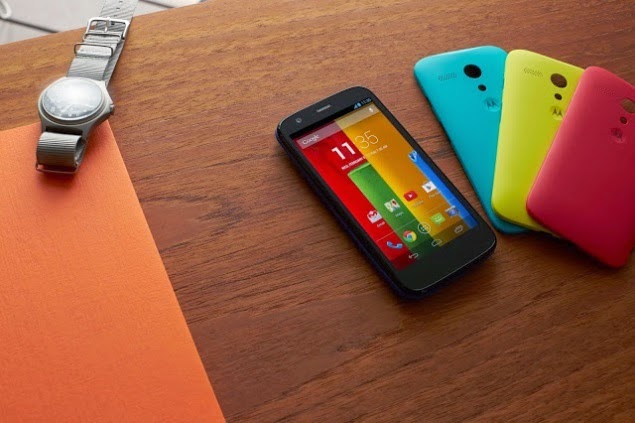
Buyers are able to customize the phone in tens of thousands of ways,
including black or white front covers, 18 different back covers, seven
accent colors for the phone’s buttons and hardware around the camera,
custom messaging on the back of the phone, unique wallpapers, and even a
custom welcome message when you power your phone on. Despite all these
customizations, Motorola will deliver your phone in under four days. The
company also offers color-matched accessories from SOL Republic like
headphones, wireless speakers, and cases from other manufacturers.
Something I was surprised Motorola didn’t mention in its messaging is
the fact that the Motorola RAZR was practically the phone that started
the entire color craze, launching a black model after the aluminum one
in the U.S. and then, obviously, in a bunch of colors soon after. But
now that I think about it, yeah, let’s not talk about the RAZR.

The Motorola Moto X is not the fastest phone in the world. It’s also
not the most cutting-edge, it doesn’t feature the biggest display, and
it isn’t the thinnest Android phone. However, there is absolutely no
doubt that the Moto X is the most amazing Android phone I have ever
used, and I think most people will agree.
Motorola’s new hero phone offers up the most seamless and integrated
Android experience on the market, and it does this without changing the
core Android experience practically at all. It is a mainstream,
consumer-focused, $199.99 mass-market phone. One that can appeal to
young kids, teenagers, professionals, men, women, and everyone else.
There are truly great, well thought out features, that together make
this phone a bona fide smash, and it really is Android’s iPhone.
It’s great to see Motorola back.